

Canadian companies are increasingly turning to global talent to solve a growing problem: a shortage of skilled technology professionals locally.
Hiring locally has become expensive and slow. Tech salaries continue to rise in cities like Toronto, Vancouver, and Montreal, and many startups are competing with large U.S. tech firms for the same engineers.
To stay competitive, businesses are exploring global hiring strategies. The rise of remote work has accelerated global talent mobility, allowing companies to build distributed teams across multiple countries. According to research from the World Bank, international talent mobility continues to reshape global labor markets. Two of the most common models are offshore staff augmentation vs outsourcing.
However, many companies confuse these two approaches.
While both involve external talent, the structure, control, and long-term outcomes can be very different.
Understanding the difference between staff augmentation vs outsourcing helps businesses choose the right model for growth, cost efficiency, and project success.
What Is Staff Augmentation?
Staff augmentation is a hiring model where companies temporarily add external professionals to their internal team.
Instead of outsourcing a project, the external professionals become an extension of your existing workforce.
For example, a Canadian software company might hire offshore developers to work alongside its in-house engineering team. These developers follow the company’s processes, attend internal meetings, and report to internal managers.
In other words, they operate as part of your team, even though they are employed externally.
Key Characteristics of Staff Augmentation
- External professionals integrate with internal teams
- The company maintains direct management control
- Workers typically focus on specific roles or skills
- Engagement can be short-term or long-term
This model is particularly common in technology roles, such as:
- Software development
- DevOps engineering
- Data engineering
- QA testing
- Cloud architecture
Many Canadian startups use offshore staff augmentation to scale development teams quickly without committing to full-time local hires.
What Is Outsourcing?
Outsourcing is a model where a company delegates an entire project or business function to an external provider.
Instead of integrating individuals into your team, the outsourcing vendor manages the work independently.
For example, a company might outsource the following:
- Mobile app development
- IT support services
- Customer support operations
- Digital marketing management
The outsourcing partner usually handles:
- Hiring and managing the team
- Project management
- Deliverables and timelines
Your company focuses mainly on defining goals and evaluating outcomes.
Outsourcing reduces internal workload but also reduces direct control over the process.
Key Differences: Staff Augmentation vs Outsourcing

The differences between outsourcing vs staffing models become clearer when comparing key factors.
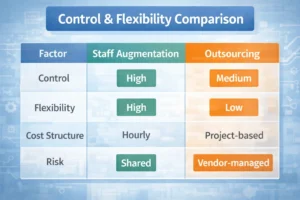
| Factor | Staff Augmentation | Outsourcing |
|---|---|---|
| Control | Managed internally | Managed by vendor |
| Team Integration | External staff join the internal team | Separate the external team |
| Flexibility | Highly flexible scaling | Less flexible |
| Cost Structure | Pay per developer or specialist | Project-based or service fee |
| Risk | Shared responsibility | The vendor assumes more delivery risk |
Control
In staff augmentation, your internal team manages the external professionals.
With outsourcing, the vendor typically manages the project independently.
Companies that want strong oversight often prefer augmentation.
Cost
Both models can reduce costs compared to local hiring.
However, cost structures differ.
Staff augmentation typically involves hourly or monthly developer rates, while outsourcing is often priced as a project contract.
This difference affects flexibility and scalability.
Flexibility
Staff augmentation allows companies to scale teams up or down based on project needs quickly.
Outsourcing is usually structured around fixed scopes, making adjustments more complex.
For fast-growing startups, flexibility is often essential.
Risk
Outsourcing providers typically assume responsibility for project delivery.
With staff augmentation, the company remains responsible for project management.
This means augmentation requires stronger internal leadership.
Companies should also ensure offshore teams are hired under proper legal structures. Our guide on How to Hire Offshore Employees Legally from Canada explains compliance requirements, contractor rules, and tax considerations.
When to Choose Offshore Staff Augmentation
Offshore staff augmentation also gives companies access to global talent pools. Our guide on Best Countries for Offshore IT Staffing explains how regions like India, Poland, and Vietnam provide strong technical expertise at competitive rates.
Canadian businesses typically choose this model when:
1. Expanding Internal Teams
If you already have a product or engineering team, adding offshore developers can increase capacity quickly.
2. Accessing Specialized Skills
Certain technical skills are difficult to find locally, including:
- AI engineering
- Machine learning
- DevOps infrastructure
- Cybersecurity
Augmentation provides access to global talent pools.
3. Maintaining Product Ownership
Companies building proprietary products often want full control over development decisions.
Staff augmentation ensures your internal leadership remains in charge.
4. Long-Term Collaboration
Unlike project-based outsourcing, augmentation can support ongoing product development.
Many companies have maintained offshore augmented teams for years.
When to Choose Outsourcing
Outsourcing can be a better option when a company prefers less operational involvement.
Businesses often choose outsourcing when:
1. Internal Resources Are Limited
If your company lacks project managers or technical leadership, outsourcing may reduce operational complexity.
2. The Work Is Non-Core
Some functions are easier to outsource entirely.
Examples include:
- Customer support
- IT infrastructure management
- QA testing services
3. Projects Have a Clear Scope
Outsourcing works well when the deliverables are clearly defined.
For example:
- Building a website
- Creating a mobile application
- Running a marketing campaign
Why Offshore Staff Augmentation Is Growing in Canada
Over the last decade, offshore staff augmentation has grown rapidly among Canadian companies.
Several factors are driving this trend.
Talent Shortage
Canada faces a shortage of skilled technology professionals.
According to the Government of Canada’s labor market analysis, demand for software engineers continues to exceed supply.
Global talent shortages are affecting multiple industries. Data from the OECD employment outlook shows that skilled technology roles remain among the hardest positions to fill globally.
Rising Salary Costs
Senior developers in Canada often earn CAD $120,000–$160,000 annually, not including benefits and overhead. As explained in our guide on Cost of Hiring Offshore Developers in 2026, offshore engineers can cost 40–70% less while offering comparable expertise.
Remote Work Normalization
The pandemic accelerated the adoption of remote work globally.
Teams are now comfortable collaborating across countries and time zones.
Access to Global Innovation
Offshore developers in countries such as India, Poland, and Vietnam bring expertise across multiple industries.
Many global companies already operate distributed teams.
Real Example: A Canadian SaaS Company
Consider a Toronto-based SaaS startup building a new analytics platform.
The company needs five additional backend engineers but struggles to hire locally.
Instead of outsourcing the project, they chose offshore staff augmentation.
They hire engineers in India and Poland who work directly with the Canadian team.
Benefits include:
- Faster hiring timelines
- Lower development costs
- Full control over product decisions
This hybrid team structure allows the company to scale without sacrificing quality or ownership.
Frequently Asked Questions
Is staff augmentation cheaper than outsourcing?
Not always. Staff augmentation usually offers lower hourly rates and greater flexibility, but outsourcing may provide predictable project pricing. The most cost-effective option depends on project scope, duration, and management capacity.
Is offshore staff augmentation risky?
Offshore staff augmentation can be safe when structured properly. Risks such as communication challenges and data security can be minimized through clear contracts, strong management processes, and reliable staffing partners.
What industries use staff augmentation the most?
Technology companies are the biggest users of staff augmentation. However, industries such as fintech, healthcare technology, and e-commerce increasingly rely on augmented teams.
Can staff augmentation be long-term?
Yes. Many companies maintain augmented offshore teams for multiple years, especially when building or maintaining software products.
Do augmented staff work full-time?
Yes. Offshore augmented professionals often work full-time schedules aligned with their client companies.
Final Thoughts
Both outsourcing and staff augmentation can help companies access global talent and reduce costs.
However, they serve different purposes.
Companies that want control, flexibility, and team integration typically prefer staff augmentation.
Companies that want minimal involvement and fixed project delivery often prefer outsourcing.
For many Canadian tech companies today, offshore staff augmentation offers the best balance between cost efficiency and operational control.
If your business is exploring offshore staff augmentation to scale development teams faster, learn more about our Offshore Staffing Services Canada and how Canadian companies are building high-performing global teams.