

Canadian companies are expanding globally faster than ever. Rising domestic salaries, talent shortages, and the normalization of remote work have made offshore hiring attractive—and practical.
But here’s the part most founders underestimate:
Offshore hiring isn’t just a payroll decision.
It’s a legal structure decision.
Let’s unpack what that means.
Why Compliance Matters
Hiring offshore without a proper structure can lead to:
- Misclassification penalties
- Tax audits
- IP ownership disputes
- Employment law violations abroad
- Data privacy fines
Many Canadian startups assume offshore workers operate “outside Canadian law.”
That’s not accurate.
You may avoid Canadian employment standards in some cases—but Canada Revenue Agency (CRA) reporting, contractual liability, and data protection obligations still apply.
The risk isn’t theoretical. It’s structural.
Employment vs Contractor: What’s the Difference?

An employee works under your control and direction, while an independent contractor provides services under a contract and maintains autonomy over how work is performed.
This distinction determines your compliance obligations.
Employee (Foreign Employee)
- You control the schedule and deliverables
- Ongoing relationship
- Company tools provided
- May trigger foreign payroll obligations
Independent Contractor
- Paid per project or monthly retainer
- Uses own tools
- Controls work methods
- Responsible for own taxes locally
Here’s where it gets tricky.
If you treat someone like an employee but classify them as a contractor, you risk misclassification penalties—both in Canada and in the worker’s country.
Many jurisdictions aggressively enforce this.
Legal Options for Canadian Companies
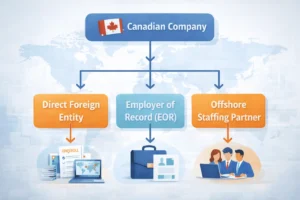
There are three primary legal ways to hire offshore workers from Canada.
Let’s break them down.
1. Direct Hiring (Foreign Entity Setup)
This means:
- Registering a company in an offshore country
- Running payroll locally
- Complying with labour laws there
This is the most complex option.
You must:
- Register for local tax numbers
- Contribute to social security programs
- Follow termination protections
- Handle employment contracts under local law
This approach makes sense for companies planning long-term presence in a specific country.
For most startups, it’s excessive.
2. Employer of Record (EOR)
An employer of record legally employs the offshore worker on your behalf.
You:
- Manage day-to-day work
- Define responsibilities
The EOR:
- Handles payroll
- Ensures tax compliance
- Manages benefits
- Handles local employment contracts
This model significantly reduces risk.
It’s especially useful when:
- You’re hiring 1–5 employees in a country
- You want compliance without entity setup
- You’re scaling quickly
3. Offshore Staffing Partner
This is often confused with EOR—but it’s different.
An offshore staffing agency:
- Recruits talent
- Employs them locally
- Provides workspace & infrastructure
- Manages HR compliance
You receive a managed team.
This reduces:
- Misclassification risk
- Administrative burden
- Compliance exposure
For Canadian businesses unfamiliar with foreign employment law, this is often the safest option.
Tax & Compliance Considerations
This is where Canadian companies must pay close attention.
CRA Considerations
If paying offshore contractors:
- You may need to issue appropriate reporting forms
- Payments must be recorded properly
- Withholding tax may apply in specific circumstances
If hiring via EOR or staffing partner:
- You typically pay a service invoice
- The foreign entity handles payroll taxes
Always consult a Canadian tax advisor regarding:
- Permanent establishment risk
- Transfer pricing rules (if applicable)
Local Labour Laws
Even if your business is in Toronto or Vancouver, the country of origin law of the offshore worker applies to them.
This includes:
- Minimum wage requirements
- Termination notice rules
- Mandatory benefits
- Holiday entitlements
Some countries have strict termination protections that surprise Canadian employers.
Data Protection & IP
If offshore workers access Canadian customer data:
- PIPEDA may apply
- Confidentiality agreements are critical
- IP assignment clauses must be airtight
Never rely on verbal agreements.
Always use written contracts specifying:
- IP ownership
- Confidentiality
- Data access boundaries
Cost Comparison: Hiring Structure Overview
| Hiring Model | Setup Complexity | Legal Risk | Ongoing Admin | Cost Level |
|---|---|---|---|---|
| Direct Foreign Entity | High | Low (if compliant) | High | High |
| Employer of Record | Medium | Low | Medium | Medium |
| Offshore Staffing Partner | Low | Lowest | Low | Medium |
1-Year Cost Example (Senior Developer)
| Structure | Estimated Annual Cost (CAD) |
|---|---|
| Canadian Hire | $165,000 |
| Offshore Contractor | $90,000 |
| Offshore via EOR | $100,000 |
| Offshore Staffing Partner | $105,000 |
Savings range from $60K–$75K per developer annually. For more info, you can read Cost of Hiring Offshore Developers 2026
Risks of Hiring Without Proper Structure

Here’s what I’ve seen happen when companies rush offshore hiring:
- Contractor reclassified as employee → backdated tax penalties
- IP ownership unclear → investor due diligence issues
- Payroll tax violations abroad → local fines
- Data breach exposure → regulatory investigation
These problems don’t show up immediately.
They surface during:
- Funding rounds
- Acquisition due diligence
- Tax audits
And that’s when they become expensive.
Why Partnering with an Offshore Staffing Agency Reduces Risk
An offshore staffing agency reduces compliance risk by legally employing the worker in their home country while providing structured contracts, HR management, and payroll compliance.
Benefits include:
- Pre-vetted employment contracts
- Proper local payroll handling
- Reduced misclassification exposure
- Centralized billing
- HR and termination support
You focus on operations. They handle compliance.
For Canadian companies entering offshore hiring for the first time, this often prevents costly legal mistakes. also you can read this blog Offshore vs Nearshore Staffing
FAQ
Is offshore hiring legal in Canada?
Yes. Canadian companies can legally hire offshore employees or contractors as long as they comply with CRA reporting rules and local labour laws in the worker’s country.
Do I pay Canadian taxes on offshore workers?
You generally do not pay Canadian payroll taxes if the worker is employed abroad through an EOR or foreign entity. However, payments must be properly recorded and structured.
Can offshore workers be full-time?
Yes. Offshore workers can work full-time, but classification (contractor vs. employee) must align with local labor laws to avoid misclassification risk.
If you want to legally hire offshore employees in Canada without risking compliance issues, explore our:
👉 Offshore Staffing Services Canada
We help Canadian companies hire offshore teams with full legal structure, payroll compliance, and HR management.