
Introduction: The High-Stakes Battle for Canadian IT Talent
Many industries in Canada are experiencing a shortage of skilled IT talent, which has created fierce competition to recruit talented individuals. There are not enough qualified IT professionals to fill current and projected positions. According to the Information, Communications Technology Council (ICTC) Canada, the Canadian economy will require over 250,000 tech workers by 2026 in order to maintain the current level of economic growth.
At the same time, the number of unemployed tech professionals remains one of the lowest among all employment sectors and, therefore, hiring professionals must rely on fewer candidates. The executive leadership, HR departments, and tech recruiters are facing a problem with respect to finding the best available candidates, as most of the high-performing applicants are already working for other companies and are involved in complex initiatives.
To overcome this challenge an organization must develop processes to attract passive candidates in Canada. As a result, companies have a strategic imperative to attract those individuals who may be at risk of becoming unemployed. To thrive in this environment, an organization must view recruiting as a proactive activity, and employ a relationship-based model in recruiting, where the organization builds long-term relationships with potential candidates.
Recruitment Best Practices in 2026: From Credentials to Capabilities
As Canadian businesses adapt to changes in technology, one of the biggest changes that they are implementing is the shift from hiring based on a degree to hiring based on the skills that an applicant has. Because of the speed of change in the IT industry, the traditional way of looking at a degree alone does not guarantee that a person will be prepared for the realities of being employed in the IT space. Instead, it is important for hiring managers to focus on an applicant’s ability to deal with real-world situations, adapt to new technologies, and work collaboratively.

Some of the largest employers in Canada, such as Shopify and the Royal Bank of Canada, have begun transitioning to skills-based hiring models by emphasizing portfolios and certifications, as well as practical assessment, rather than only considering a potential employee’s academic credentials. This allows companies to consider many more individuals for job opportunities and gives hiring managers the ability to find high-performing individuals who otherwise may not have been considered. Hiring teams are also increasing the use of Artificial Intelligence (AI) in partnership with Human Resources (HR) to help streamline the hiring process through use of AI-driven tools for screening resumes, matching skills, and providing predictive analytics to reduce the time it takes to fill job openings and eliminate unconscious bias.
However, many Canadian hiring managers are becoming aware of the need for transparency and fairness when it comes to the use of AI in hiring decisions. Being open and transparent with applicants about the way that AI is being used to make hiring decisions will help to build trust with applicants, especially with passive candidates who may be less likely to apply because of uncertainty around the recruiting process and the use of AI. Employers must make their recruiting process feel personal, even if it is done very efficiently. It is essential that hiring managers develop personal relationships with talented passive candidates before engaging them in any substantive way.
Designing a Sophisticated Talent Sourcing Strategy in Canada
There is a significant difference between how most businesses use a traditional way of hiring and how they should be using a more proactive method when recruiting talent within the Canadian market. A traditional hiring model typically uses a reactive sourcing model; businesses will simply post their roles and wait for applications to come to them. The most successful talent sourcing strategy in Canada utilizes a more proactive approach to sourcing talent by Market Mapping and identifying where top tier talent works, what emerging skill sets exist, and how individuals are progressing through an industry before any positions become available. With the use of advanced sourcing techniques, organizations have begun tracking behaviors to predict who’s likely to be looking for a new job in the future.
For instance, individuals actively engaging on LinkedIn, developing open-source contributions on GitHub or attending local Canadian tech meetups signify an openness towards exploring other career opportunities. According to LinkedIn’s Global Talent Trends Report, it is projected that 70% of the global workforce are passive candidates; however, if approached in a careful and articulate way, many will welcome the opportunity to become re-engaged with a company or organization. The difference between approaching candidates flagged as passive compared to those who are actively looking for work boils down to one key element, the quality of the outreach.
When companies craft personalized outreach messages highlighting why the role being filled would align with what the candidate is currently doing well within their career, their outreach will be more successful than doing so with generic job offers. In essence, successful recruiters are now transforming the way they source talent from a disruptive, transactional approach to one based on creating lasting relationships—thereby allowing them to better attract the passive Canadian market.
Employer Branding: The Silent Ambassador That Wins Passive Talent
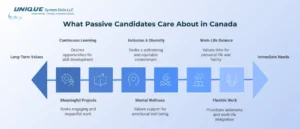
Often the determining factor as to whether conversations will begin with passive candidates is the employer brand. Passive candidates are not motivated by urgency as they are not actively seeking employment, but instead, they find meaning in their work, stability in their employer, and alignment with their values. An effective employer brand is a “silent ambassador” that helps shape candidates’ perceptions of employers before they have even had a recruiter contact them. In Canada, where work/life balance, inclusion, and social responsibility are highly regarded, companies that communicate those priorities have a competitive advantage.
According to a Workday Report, 83% of professionals agree that human-centered skills are becoming more vital, as new technologies are becoming more prevalent. This means building a workplace culture ready to embrace new technologies, adapt quickly to change, and harness major technological advancements.

By providing flexible work options, mental wellness programs, and opportunities to contribute to meaningful projects, companies can have a substantial impact on attracting passive talent. One of the most powerful ways to communicate company culture is through employee testimonials. When prospective candidates hear authentic and relatable stories from current employees, it builds more trust and credibility than any company’s message ever could. Progressive companies are putting a greater emphasis on highlighting how adding new cultures will improve their team rather than focusing exclusively on fitting into existing cultural norms. This approach will not only assist companies with attracting passive candidates, but it will also help with long-term innovation and retention.
Building Strong Talent Pipeline in Canada Through Education and Community
To achieve sustainable recruiting and retention outcomes, employers need to leverage their foresight rather than solely rely on speed. In order to building strong talent pipelines in Canada, it is necessary to identify future-ready talent at an early stage and build relationships over time. Establishing a strong talent pipeline in the IT industry will require a focus on these types of relationships due to the industry’s ongoing talent shortages. One key factor in building strong relationships with future-ready talent is through educational partnerships.
By partnering with colleges and universities, polytechnics, and coding boot camps, employers have the opportunity to identify “raw” or potential talent before their competitors do. Offering co-op and internship programs along with funding for certification programs gives employers the ability to develop and prepare talent for real world business challenges in the IT sector. According to Universities Canada, more than 60% of employers who provide co-op placements convert those students into a full-time position within their organization.
Equally critical to the long-term development of a diverse workforce is the implementation of inclusive apprenticeship models. For example, the IT Apprenticeship Program for Indigenous Peoples is designed to provide access and remove barriers for underrepresented talent pools while simultaneously supporting and strengthening employers’ brand equity.
Additionally, these programmes are also designed to address the long-term workforce shortage in Canadian employers. One method for organisations to keep engaged with potential future-ready talent is through the use of Talent CRM platforms. Talent CRM platforms allow recruiters to build relationships and nurture “warm leads” through the use of tailored content, even when no current role is available. This enables organisations to engage and attract passive candidates in Canada who will remember your organisation when they have an opportunity to change jobs and timing aligns.
Internal Mobility: Unlocking the Hidden Talent Within
As important as sourcing outside of your organization is, a lot of people overlook one of the most valuable resources that you have: your current employees. In 2026, internal mobility has been one of the cornerstones of best practices in recruitment because it provides organizations with a low-risk, cost-effective option for filling critical positions. Internal candidates already have an understanding of the company’s culture, systems, and expectations of them, thereby reducing both the time frame for onboarding new hires as well as their cost to ramp up quickly. According to research conducted by Deloitte, organizations that offer strong internal mobility programs have employees that retain their jobs nearly 2 times longer than organizations that do not invest in them.
Along with behavioral assessments and skills assessments that align individuals with the roles in which they flourish, these programs have been proven to increase employee engagement, attract passive candidates in Canada, increase employee productivity, and develop future leaders, while at the same time, demonstrating to potential passive external candidates that the company is genuinely investing in their development and career growth. A well-structured internal succession plan allows your organization’s investment in their human capital to be evident to current employees and will also establish your company as a credible employer in the eyes of the public.
Measuring What Matters: Turning Strategy Into Results
Success cannot be achieved unless recruitment is treated as a measurable business function. By tracking performance metrics (i.e., time-to-fill, cost-per-hire, quality-of-hire, retention rates), organizations can assess the effectiveness of their recruitment efforts. By tracking pipeline-sourced hires, organizations can compare them to traditional applicants and see how much better off they would have been if they had focused efforts more aggressively on attracting passive candidates.
This information justifies continued investment in proactive sourcing, employer branding, and talent technology. The use of data-driven refinement leads to recruitment evolving from a reactive cost center to a strategic growth driver that continually attracts passive candidates to Canada.
Organizations can improve their recruitment results by partnering with workforce experts at Unique System Skills. Flexible models such as contract staffing, contract-to-hire, offshore staffing, and direct placements allow for greater visibility of critical key metrics (measured over time) including time-to-fill, quality-of-hire, conversion rate and retention rates, enabling measurement of the success of pipeline driven and internal mobility versus traditional methods of hiring.
This measurement-first approach changes the way recruitment is viewed from an intuitive process to a performance-driven strategy, delivering long-term ROI for an organization by continuously improving the process of attracting and deploying top talent across Canada.
Conclusion: Future-Proofing Your Recruitment Strategy
The market of IT talent in Canada is expected to be increasingly competitive. Businesses that only look for active job candidates to fill vacancies may lose out on potential talent. Companies with a long-term strategy for engagement with potential job candidates will be able to leverage the ability to attract passive candidates in Canada and build authentic employer brands, both of which provide them with a distinct advantage over the competition. Picture a recruitment process that allows you to engage your potential talent before roles become available, where hiring is an intentional practice and where your teams can be established in such a manner that they are set up for future success.
The use of proven methodologies with a committed leadership team can help you achieve this vision. Organizations like Unique System Skills support this scalable hiring.
If you are an executive who is ready to “modernize” your company’s talent acquisition strategies, then your next steps should be to invest in the development of experience and trust and create strategic recruitment tactics that consistently attract the passive candidates in Canada to develop a strong future for your organization.