
Canadian businesses are facing a hiring reality shift.
Talent shortages, rising salaries, and longer recruitment cycles are making traditional hiring slower and more expensive. At the same time, companies need to move faster—launching products, scaling teams, and adapting to market changes.
That’s where the benefits of contract staffing for businesses are becoming a strategic advantage.
Instead of hiring full-time employees for every role, companies are leveraging contract professionals to stay agile, reduce costs, and access global expertise.
Let’s break down the real advantages.
Why Companies Use Contract Staffing
Companies use contract staffing to reduce hiring time, control costs, and access specialized talent without committing to long-term employment.
According to labour market insights from the Government of Canada, demand for skilled professionals continues to outpace supply in many sectors, especially technology.
Source: Government of Canada Labour Market Insights & OECD Employment Outlook
This imbalance is one of the biggest reasons why contract staffing for businesses is growing rapidly.
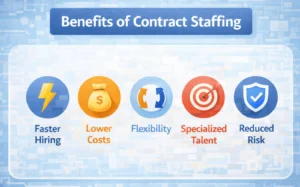
Here are 7 Benefits of Contract Staffing for Canadian Companies
1. Faster Hiring
Contract staffing significantly reduces hiring timelines, allowing companies to fill roles in weeks instead of months.
Traditional hiring often takes:
- 6–12 weeks (or longer)
- Multiple interview rounds
- Negotiation delays
In contrast, contract professionals are often:
- Pre-vetted
- Immediately available
- Ready to start within days or weeks
Real Scenario
A Toronto SaaS company needed a DevOps engineer urgently.
Instead of waiting 2–3 months for a full-time hire, they onboarded a contractor in under 2 weeks, avoiding project delays.
2. Lower Recruitment Costs
One of the biggest advantages of contract staffing is reduced recruitment and overhead costs.
Full-time hiring includes:
- Recruitment agency fees
- HR time and effort
- Onboarding costs
- Benefits and insurance
Contract staffing eliminates many of these expenses.
Cost Comparison Example
| Cost Factor | Full-Time Hire | Contract Staffing |
|---|---|---|
| Recruitment Fees | High | Low/Included |
| Benefits | Yes | No |
| Payroll Taxes | Yes | No |
| Flexibility | Low | High |
This makes contract staffing especially attractive for startups and growing businesses.
3. Workforce Flexibility
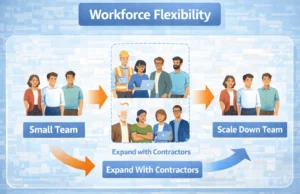
Contract staffing allows companies to scale teams up or down based on project needs.
This is one of the most important benefits of contract staffing.
Instead of committing to long-term employment, businesses can:
- Add resources during peak demand
- Reduce team size after project completion
- Adjust quickly to market changes
Example
An e-commerce company may hire developers during peak product development phases and reduce team size after launch.
This flexibility is difficult with traditional hiring.
4. Access to Specialized Talent
Contract staffing provides access to highly specialized professionals that may not be available locally.
Many Canadian companies struggle to hire:
- AI engineers
- Cloud architects
- DevOps specialists
- Cybersecurity experts
Contract staffing opens access to a global talent pool.
For example, companies often combine contract hiring with global talent strategies. Our guide on Cost of Hiring Offshore Developers in 2026 explains how businesses access specialized skills at lower costs.
5. Reduced Long-Term Commitment
Contract staffing reduces the risk associated with long-term hiring commitments.
Full-time hiring involves:
- Long-term salary obligations
- Termination complexities
- Legal compliance
Contract staffing allows businesses to:
- Hire for specific projects
- Evaluate talent before long-term commitment
- Avoid long-term financial liabilities
This is particularly valuable for startups operating with a limited runway.
6. Faster Project Execution
Contract professionals can accelerate project timelines by filling critical skill gaps quickly.
Instead of delaying projects due to hiring constraints, companies can bring in experienced contractors who:
- Require minimal training
- Have proven expertise
- Deliver results faster
This is one reason why companies use contract staffing: it is closely tied to speed and execution.
7. Better Resource Allocation
Contract staffing allows companies to focus internal teams on strategic priorities while contractors handle execution tasks.
For example:
- Internal team → Product strategy
- Contractors → Development and execution
This improves productivity and ensures internal resources are used effectively.
Contract Staffing vs Traditional Hiring
| Factor | Contract Staffing | Full-Time Hiring |
|---|---|---|
| Hiring Speed | Fast | Slow |
| Cost | Lower upfront | Higher long-term |
| Flexibility | High | Low |
| Risk | Low | Higher |
| Commitment | Short-term | Long-term |
When Should Canadian Companies Use Contract Staffing?
Contract staffing is ideal when:
- You need to scale quickly
- You require specialized skills
- You want to reduce hiring risk
- You are managing short-term projects
- You need flexibility in workforce planning
Many companies also combine contract staffing with offshore strategies.
Learn more in our guide on Best Countries for Offshore IT Staffing to understand global talent opportunities.
FAQ
What are the benefits of contract staffing?
The benefits of contract staffing include faster hiring, lower costs, workforce flexibility, and access to specialized talent. It allows businesses to scale efficiently without long-term commitments.
Why do companies use contract staffing?
Companies use contract staffing to reduce hiring time, control costs, and quickly access skilled professionals for short-term or specialized projects.
Is contract staffing cheaper than full-time hiring?
In many cases, yes. Contract staffing reduces recruitment costs, benefits, and long-term financial commitments, making it more cost-effective for short-term needs.
What industries use contract staffing the most?
The technology, healthcare, finance, and engineering industries frequently use contract staffing due to high demand for specialized skills.
Can contract staffing be long-term?
Yes. While typically used for short-term projects, many companies retain contract professionals for extended periods based on business needs.
If your business needs flexibility, faster hiring, and access to specialized talent:
👉 Explore our Contract Staffing Services
👉 Or combine with global talent using our Offshore Staffing Services