
Canadian companies are facing a reality shift.
Domestic tech salaries continue to rise. Competition with U.S. remote employers has intensified. And specialized roles—AI engineers, DevOps architects, cybersecurity analysts—are increasingly difficult to fill locally.
This global talent shortage is not temporary.
As a result, more Canadian startups and mid-sized companies are turning to the best countries for offshore staffing to stay competitive.
But the question remains:
Which country actually delivers the best balance of cost, quality, and reliability?
Let’s evaluate them properly.
How We Evaluated the Countries
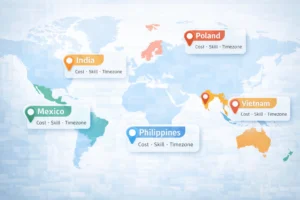
Before listing the best countries for offshore staffing, we applied four core criteria that matter specifically to Canadian businesses.
1. Cost
We analyzed:
- Average hourly developer rates
- Full-time annual cost equivalents
- Long-term scaling potential
Affordability matters—but ultra-low cost without quality is expensive in the long run.
2. English Proficiency
Communication is often the biggest friction point in offshore projects.
We assessed:
- Business-level English fluency
- Cultural communication style
- Written documentation quality
Miscommunication can cost more than salary savings.
3. Technical Skill Depth
We evaluated:
- Size of developer talent pool
- Engineering education standards
- Specialization availability (AI, cloud, cybersecurity)
- Global outsourcing reputation
Depth matters more than numbers alone.
4. Time Zone Compatibility
Canadian businesses value overlap hours.
We assessed:
- Overlap with Eastern & Pacific Time
- Flexibility of offshore teams
- Real-time collaboration feasibility
With those criteria in mind, here are the top offshore IT staffing countries for 2026.
India
India remains the global leader in offshore IT staffing.
Strengths
- Largest developer population globally
- Deep expertise in software engineering, AI, cloud, and enterprise systems
- Mature outsourcing ecosystem
- Strong English proficiency
India has built its tech outsourcing industry over the decades. Many Fortune 500 companies rely heavily on Indian offshore teams.
Average Rates (2026)
- Mid-level developer: CAD $25–$45/hour
- Senior developer: CAD $40–$60/hour
- Annual equivalent: CAD $60K–$100K
Best For
- Scaling engineering teams
- Complex enterprise projects
- Cost-sensitive startups
When comparing offshore developers in India vs Philippines, India typically offers deeper technical specialization and larger scalability.
However, the time zone difference (9.5–12.5 hours) requires a structured workflow.
Philippines
The Philippines is one of the most communication-friendly offshore IT staffing countries.
Strengths
- Exceptional English fluency
- Cultural alignment with North America
- Strong web development and support capabilities
- Growing software engineering sector
Filipino developers are often praised for clear communication and adaptability.
Average Rates (2026)
- Mid-level developer: CAD $20–$35/hour
- Senior developer: CAD $30–$45/hour
- Annual equivalent: CAD $50K–$80K
Best For
- Customer-facing platforms
- Web & frontend development
- Support-heavy technical teams
In offshore developers India vs Philippines comparisons, the Philippines often wins on communication, while India leads in engineering depth.
Poland
Poland represents the premium European offshore option.
Strengths
- Strong STEM education
- High engineering standards
- Cultural alignment with Western businesses
- Strong cybersecurity & fintech talent
Poland consistently ranks high in global developer skill assessments.
Average Rates (2026)
- Mid-level developer: CAD $45–$65/hour
- Senior developer: CAD $60–$75/hour
- Annual equivalent: CAD $90K–$130K
Best For
- Fintech
- Cybersecurity
- High-performance backend systems
Cost savings are lower than in Asia, but quality and reliability are high.
Time zone difference (6–9 hours) is more manageable than Asia for Eastern Canada.
Mexico
Mexico is rapidly growing as a nearshore alternative.
Strengths
- Strong timezone alignment with Canada
- Growing tech hubs (Guadalajara, Monterrey)
- Increasing bilingual workforce
- Easier travel & cultural familiarity
Mexico provides strong real-time collaboration advantages.
Average Rates (2026)
- Mid-level developer: CAD $35–$55/hour
- Senior developer: CAD $50–$65/hour
- Annual equivalent: CAD $75K–$115K
Best For
- Agile product teams
- Companies prioritizing collaboration
- Hybrid offshore models
Mexico may not match India’s scale, but its timezone compatibility is a major advantage.
Vietnam
Vietnam is one of the fastest-growing offshore IT staffing countries.
Strengths
- Highly cost-efficient
- Strong math and engineering education
- Growing startup ecosystem
- Increasing English proficiency
Vietnam’s tech outsourcing industry has matured significantly in the last decade.
Average Rates (2026)
- Mid-level developer: CAD $20–$35/hour
- Senior developer: CAD $30–$50/hour
- Annual equivalent: CAD $50K–$85K
Best For
- Early-stage startups
- Cost-focused scaling
- Mobile app development
The time zone difference is similar to India, requiring asynchronous management.
Country Comparison Table
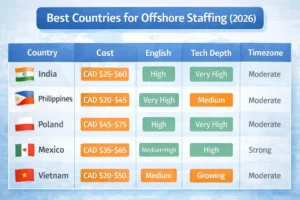
| Country | Hourly Rate (CAD) | English Proficiency | Tech Depth | Time Zone Overlap | Best For |
|---|---|---|---|---|---|
| India | $25–$60 | High | Very High | Moderate | Scalable engineering |
| Philippines | $20–$45 | Very High | Medium | Moderate | Web & support |
| Poland | $45–$75 | High | Very High | Moderate | Enterprise & fintech |
| Mexico | $35–$65 | Medium-High | High | Strong | Agile collaboration |
| Vietnam | $20–$50 | Medium | Growing | Moderate | Cost-focused scaling |
Which Country Is Best for Your Business?
There is no universal winner.
Here’s how I advise Canadian clients:
1. Early-Stage Startup
India or Vietnam
Maximum cost efficiency + scalability.
2. Growth-Stage SaaS
India + Philippines hybrid
Engineering depth + communication balance.
3. Regulated or Fintech
Poland
Higher engineering standards and a strong compliance culture.
4. Collaboration-Heavy Teams
Mexico
Time zone alignment improves speed.
The best countries for offshore staffing depend on your:
- Growth stage
- Technical complexity
- Budget flexibility
- Internal management maturity
Many Canadian companies now use hybrid models:
- Core architecture in Canada
Development offshore
Support nearshore
That balance reduces risk and improves speed.
Frequently Asked Questions (FAQ)
What are the best countries for offshore staffing in 2026?
India, the Philippines, Poland, Mexico, and Vietnam are considered the best countries for offshore staffing due to their cost efficiency, talent availability, and growing IT infrastructure.
Is India better than the Philippines for offshore developers?
In offshore developers India vs Philippines comparisons, India typically offers deeper technical specialization and scalability, while the Philippines offers stronger English fluency and communication advantages.
Which offshore country has the lowest developer rates?
Vietnam and the Philippines typically offer the lowest hourly rates, starting around CAD $20–$25 per hour for mid-level developers.
Is Mexico considered offshore or nearshore for Canada?
Mexico is considered nearshore for Canadian companies due to its timezone alignment and geographic proximity.
Does Poland offer better quality than Asian offshore markets?
Poland is known for high engineering standards and strong cybersecurity expertise, though at higher rates than Asia.
Final Thoughts
Offshore IT staffing is no longer just about cost.
It’s about:
- Talent access
- Speed to market
- Competitive advantage
- Risk management
Canadian businesses that approach offshore hiring strategically—not reactively—gain leverage.
Those who choose based purely on hourly rate often pay for it later.
If you’re evaluating offshore IT staffing countries and want structured support choosing the right region and building compliant teams:
👉 Explore Our Offshore Staffing Services
We help Canadian companies hire vetted offshore developers in India, the Philippines, Poland, Mexico, and Vietnam — with structured onboarding and compliance oversight.