

Canada’s labour market has gone through a lot of upheaval and change over the last 10 years due to factors such as global events and technological advances. However, one city has been the most resilient throughout these ups and downs: Toronto. About talent acquisition, the executives who lead organizations have gone from debating the importance of Toronto, to figuring out how they can effectively compete within that marketplace. The Staffing demand in Toronto continues to surge because the city sits at the intersection of finance, technology, policy, and global capital. This makes Toronto the country’s most influential employment engine.
This blog discusses why Toronto is unmatched as well as how the provinces of Ontario are driving the economics of national recruitment, and what the fill-in HR and recruitment authorities should be aware of to maintain their competitive advantage within the highly competitive market for recruitment and talent in the country.
The Unrivalled Appeal of the Toronto Job Market
The size, scope and strength of Toronto’s economy demonstrate a clear advantage over other Canadian cities and will continue to do so. Toronto is the largest city by economic volume in Canada and serves as the economic center for the Greater Toronto Area (GTA). The city also benefits from outstanding transportation networks, high population density, and international links. In addition, Ontario has been a leader in employment growth with an increase of employment by 67,000 in October 2025, and the employment rate rose to 60.8%.
The Industries
Toronto’s ability to maintain its hiring momentum despite periods of slow growth in other parts of Canada is what separates it from other cities. While provinces across Canada have had varying degrees of success, staffing demand in Toronto remains structurally resilient due to the diverse industry exposure. These industries include:
- Finance
- Professional Services
- Healthcare
- Manufacturing
- Technology
These industries are expanding and growing at similar rates, thereby minimizing the potential impact on recruiting in the event of a downturn in any one industry. For executives, this creates a new reality. Hiring in Toronto is no longer reactive, it requires deliberate workforce planning, data-driven sourcing, and flexible engagement models to remain competitive. Especially where the market where talent has options.
Top Provinces for Staffing in Canada
When assessing the top provinces for staffing in Canada, four regions dominate national employment outcomes: Ontario, Quebec, British Columbia, and Alberta. Collectively, these provinces account for approximately 88% of all Canadian jobs.
Among them, Ontario stands apart. The province alone represents more than 40% of Canada’s total employment, driven largely by Toronto and Ottawa. This concentration creates a gravitational pull for both domestic and international employers seeking scale, talent diversity, and regulatory predictability.

Quebec offers strength in aerospace and pharmaceuticals, British Columbia leads in clean tech and gaming, and Alberta is rapidly diversifying beyond energy. Yet none match Ontario’s ability to deliver volume, specialization, and consistency at once. This is why Staffing demand in Toronto continues to outperform other provinces, even when regional hiring slows elsewhere.
For recruitment leaders, understanding provincial dynamics is essential, but success increasingly depends on mastering Toronto’s hyper-competitive ecosystem.
Employment Services Revenue in Ontario
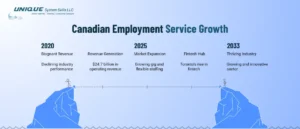
The tremendous number of worker hires happening in the province of Ontario is evident from the revenue reported. The Canadian Employment Services Industry, which includes temp agencies, Recruiting and Executive Search Firms and Temporary Help Firm, generated $24.7 billion in total operating revenue in 2023, which represents a growth of +5.2% compared to last year.
Ontario’s contribution to this number is the largest contributor. The presence of the Toronto Stock Exchange (TSE), major banks, insurance companies and international corporations has created a tremendous amount of executive hiring, contract staffing and specialized recruiting. This directly fuels employment services revenue in Ontario, making the province the financial backbone of Canada’s staffing industry.
As the appeal for traditional temp staffing methods is declining, the growth of the on-demand and platform-based temporary staffing models has accelerated and is expected to continue over the next decade. The estimated Canadian GIG and Flexible Staffing Market will reach USD 12.3 billion USD by 2033.
Employers in Toronto are at the forefront of this transformation by embracing the development of AI-powered Candidate screening, Skills-based hiring and implementing Contract-First Workforce Models as a means of addressing the growing shortage of skilled workers.
Major Metropolitan Areas in Staffing: Toronto vs. the Rest
The cities of Toronto, Montreal, Vancouver, Calgary, Edmonton, and Ottawa are the major metropolitan areas in staffing in Canada. Yet Toronto consistently ranks first across multiple dimensions: job volume, wage growth, specialization, and international hiring activity.
Toronto employs more professionals in financial services than any other Canadian city and has become North America’s third-largest fintech hub, behind only New York and San Francisco.
Montreal is very successful in recruiting bilingual employees and in attracting research and development jobs; Vancouver has many digital media and gaming companies located there; and Calgary has many jobs in the robotics and logistics industry. However, staffing demand in Toronto outpaces these cities because it combines all these strengths into a single, scalable ecosystem.
Since Toronto has the highest density of employers and potential employees, and its placement process is the fastest among those of other major Canadian urban centers, Toronto is considered to be the primary market for foreign staffing agencies that are entering Canada.
Staffing Demand in Toronto for IT and Technology Roles
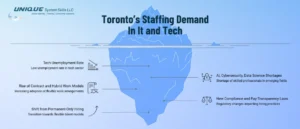
Technology is the single largest driver behind today’s Staffing demand in Toronto. As of May 2025, Canada has an overall unemployment rate of 3.3% in the tech sector, resulting in a shortage of qualified talent. The city of Toronto, being the financial center of the country, only compounds this issue because banks and other financial institutions, healthcare systems, manufacturers, etc., are all competing for the same digital job skill sets. The estimated median annual wage for a technology worker in Canada is $88,233 (CAD), which is 48% higher than the median national wage for all occupations.
Some of the highest demands for job candidates are for:
- AI / Machine Learning Engineers
- Cyber Security Analyst
- Cloud Engineer / DevOps Engineer
- Data Scientist/Data Analyst
Many employers have begun implementing a more “skills first” focus in their hiring practices – and are using contracted employees. Various studies have demonstrated that companies that implement a “skills-based” hiring process will have a 98% more chance of retaining their top performers over those who do not follow this practice.
Ultimately, this sophisticated way of thinking about hiring strategies will revolutionize the recruitment process within the city of Toronto.
Compliance, Flexibility, and the New Hiring Reality in Ontario
In order to fill vacancies in Toronto today, hiring is more than just being quick; it is also about being able to be compliant and agile. Employers must now follow the new Ontario Working for Workers Act and the upcoming Pay Transparency Regulation by disclosing salary ranges and indicating if they use Artificial Intelligence in their hiring processes. By 2026 these new regulations will go into effect.
By establishing fairness through these new regulations, HR leaders will have increased challenges in managing this change. Many organizations are using flexible staffing models that reduce risk and costs in response to changes in employment regulations and requirements. Currently, the trend toward hiring contract professionals, project-based employees, and on-demand workers is rapidly increasing.
As a result of this shift in flexible staffing, companies in Toronto are experiencing increased staffing demand in Toronto. There also a clear understanding of local employment laws, evolving compliance, and workforce flexibility at a larger scale.
Toronto Redefines the Top Provinces for Staffing in Canada
Ontario’s leadership reshapes the competitive landscape for the top provinces for staffing in Canada. With the largest number of residents, Ontario has redefined the competitive environment of the labour market in Canada. This is significantly impacting the overall recruiting environment across the country. British Columbia and Quebec are each focused on developing innovative recruitment solutions for specific industries; however, the City of Toronto, through its regulatory structure, use of technology, and recruitment techniques, is setting the bar for all provinces in Canada.
The introduction of Artificial Intelligence (AI) tools for recruiting throughout the Greater Toronto Area (GTA), has allowed companies to reduce their cost-per-hire by as much as 30% and has dramatically reduced the length of time it takes to fill a position.
The adoption of Blockchain based credential verification systems and automated Onboarding processes is also growing in popularity, especially among regulated industries such as Finance and Healthcare.
The innovations discussed above are establishing Toronto as a pilot location for the evolution of modern recruitment, where human experience and automation are working together in harmony to create an efficient hiring process.
How Unique System Skills Help Meet Toronto’s Staffing Demand
We know that the Staffing demand in Toronto is increasing quickly across several industries. With this trend continuing and many organizations needing to fill critical roles quickly, employers need reliable partners that can provide quality talent promptly. Unique System Skills (USS), a staffing agency has taken on a strategic role, including support for employers seeking expert assistance in filling key positions within the Greater Toronto Area and surrounding regions.
Requirement-based Staffing
USS connects companies with technology (IT) employees as well as other skilled professionals through permanent, temporary, contract-to-hire and direct hire services based on the unique requirements of each employer. The agency established a methodology to identify and meet employer’s specific requirements including technical skills, cultural fit and team dynamics.
Extensive Database
To achieve its staffing objectives USS relies on recruiting talent from an expansive database of candidates that is updated regularly through an extensive network. All of the recruiters use a series of very rigorous and thorough procedures to ensure only the very best candidates are accepted for placement.
Customized Staffing Solutions
The agency is committed to reducing time-to-hire, increasing retention and providing employers with qualified talent that meets the growing demand for skilled employees by focusing on finding qualified candidates that are the right fit to meet the employer’s expectations in terms of skills and experience.
Moreover, USS provides flexibility through contract-to-hire options, allowing Toronto employers to evaluate performance and fit before committing to permanent roles — an increasingly popular practice in a competitive labour market. With compliance support and onboarding assistance included, USS helps companies scale effectively, manage workforce costs, and ensure a smooth hiring journey from first contact to full integration into the team.
Executive Takeaways: Winning in Canada’s Most Competitive Market
It is evident to HR/recruitment leaders that the Staffing demand in Toronto is continuing on an upward trend. In the immediate term, there is still no sign of deceleration; however, the workforce is evolving to place increasing importance upon specialization, regulation, and competition. The following three strategic shifts will create a framework for achieving competency in the marketplace:
- Adaptive flexible workforce models to help employers manage costs and volatility.
- Emphasis upon skills rather than credentials will allow employers to tap into a diverse pool of talent.
- Utilization of data and local subject matter experts to help employers understand regulatory compliance and competing employers.
The sooner executives take action the sooner they will move hiring from a bottleneck to a strategic advantage.
Conclusion: Securing Your Competitive Edge in Toronto
Toronto’s infrastructure, talent density, and economic power are unparalleled in Canada. The city’s talent pool and capacity for attracting investors and innovators, as well as global talent, are what makes staffing demand in Toronto greater than that of any other city in Canada.
Organizations that are willing to be flexible and embrace transparency, adaptability, and modern recruiting methods will be positioned for tremendous growth in the Recruiting Market. And to move the hiring quickly, retain highly-skilled workers longer, and feel confident in compliance, these organizations are partnering with agencies like Unique System Skills in Canada’s growing market.
The talent war in Canada is being decided in one city. The question for executives is no longer why Toronto, but how ready are you to compete within it.